
How music shaped rave outfits, graphics and T-shirts
From Acid House and the Second Summer of Love to Goa trance, free parties, teknivals and today’s electronic music scenes, rave culture has constantly changed the way people dress, design and communicate.
This is the story of how music movements shaped rave fashion, graphics and the T-shirts that became part of the culture.
Rave culture has never had one look.
The clothes changed because the music changed. The music changed because people moved, cities changed, technology changed, and new scenes appeared in places nobody expected. And somehow, the T-shirt was always there.
Sometimes it was just a cheap tee bought at the party. Sometimes it carried the name of a sound system, a logo, a political message or a completely fucked-up graphic that made sense only at four in the morning. A T-shirt could tell you what music someone was into, where they had been, which crew they followed or simply that they were part of something.
Looking at rave culture through its clothes and graphics is therefore another way of looking at its history.
ACID HOUSE
In the late 1980s, Acid House changed more than the music. In Britain, a new club and warehouse culture was developing around the Roland TB-303, house music and a growing network of parties that increasingly moved outside conventional nightlife. By 1988, the so-called Second Summer of Love had turned this underground movement into a much wider cultural phenomenon. The London Museum’s Acid House collection documents how illegal raves were organised in warehouses and former industrial buildings, while clubs such as Shoom, Future, The Trip and Spectrum became important venues for the emerging scene.
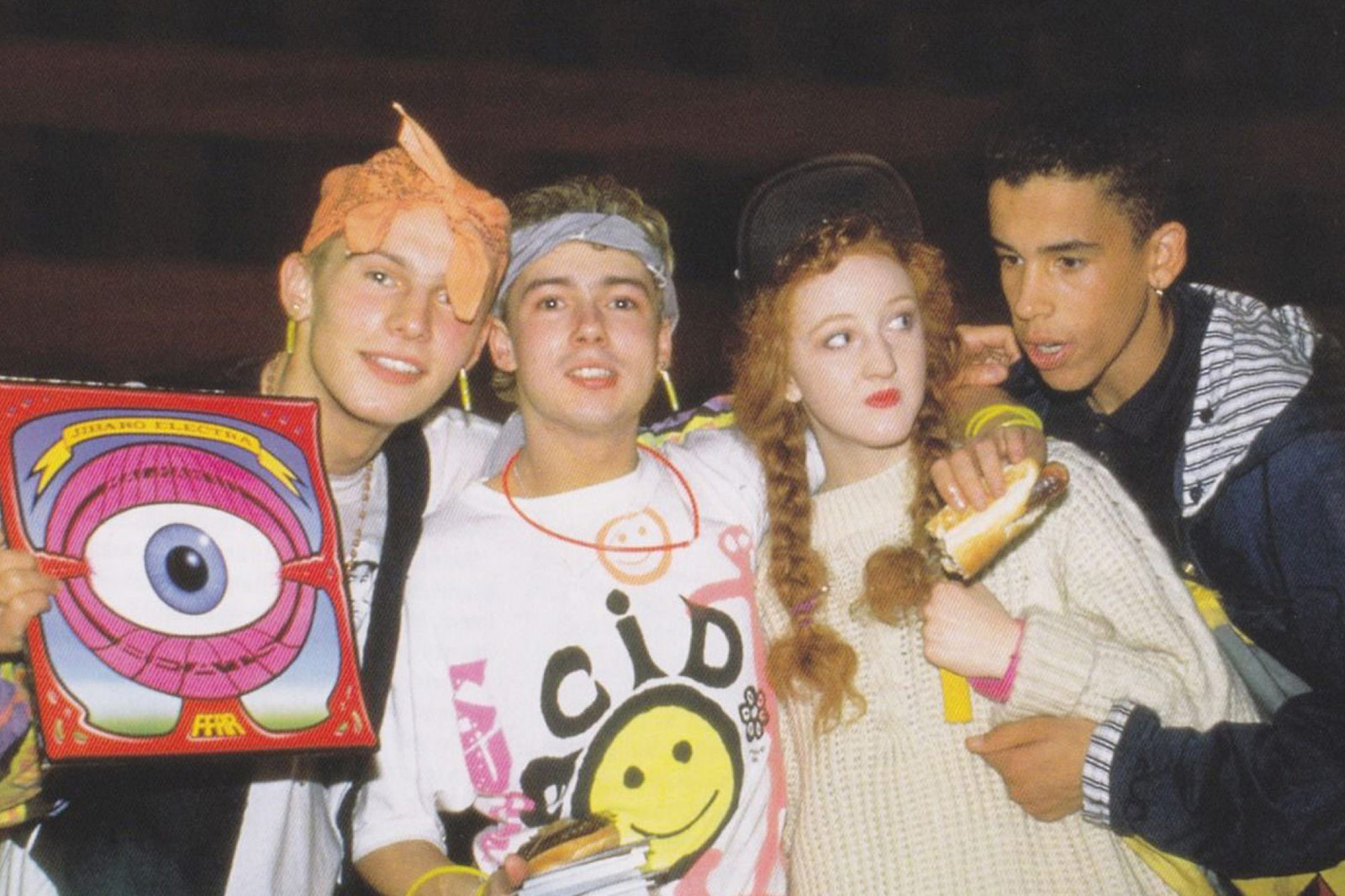
The visual language was immediate and easy to reproduce. Smiley faces, fluorescent colours, psychedelic shapes, distorted typography, cartoon imagery and cheap photocopied flyers became part of the world around the music. Flyers were often made quickly and distributed through record shops, clubs and personal networks, so their roughness was part of the aesthetic rather than something to hide.
That same DIY attitude appeared on clothing. T-shirts were cheap, easy to print and easy to wear, making them an obvious surface for the graphics of the scene. Loose silhouettes, trainers and sportswear also made practical sense for people spending hours dancing in warehouses, clubs and outdoor parties. What someone wore was not necessarily a carefully constructed “rave outfit” in the modern sense. It was often just what worked for being there.
The T-shirt nevertheless started to become part of the communication system. The famous yellow smiley became the most recognisable symbol of Acid House, appearing on badges, hats and T-shirts. The London Museum has an original Acid House badge from around 1988 in its collection, showing how quickly the smiley became an identifiable symbol of the scene.
The result was a visual language that could be recognised instantly. Baggy tees, loose jeans, trainers and brightly coloured graphics became associated with the new culture. Some shirts used simple words such as “ACID” or “HOUSE”, while others reproduced the chaotic look of flyers, with warped letters, psychedelic shapes and cartoon imagery.
But the success of those images also exposed a problem that would follow rave culture for decades. Once a visual language became recognisable, it could be copied and sold outside the scene. The London Museum notes that the Acid House scene became heavily commercialised after 1988.
Meanwhile, the music and the people around it were already moving towards something else.
THE FREE PARTY: MUSIC LEAVES THE CLUB
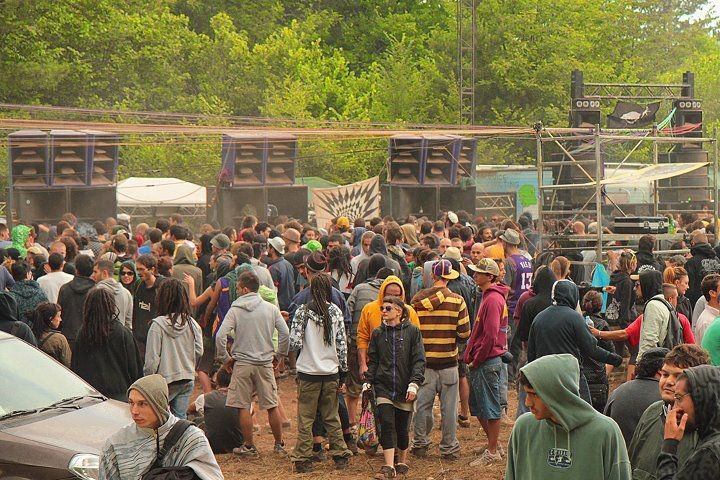
The next transformation happened when rave culture increasingly moved outside clubs and into warehouses, fields, abandoned buildings and temporary spaces. In Britain, free parties brought together clubbers, New Age travellers, squatters and sound systems, creating events that did not depend on conventional venues or the commercial nightlife infrastructure.
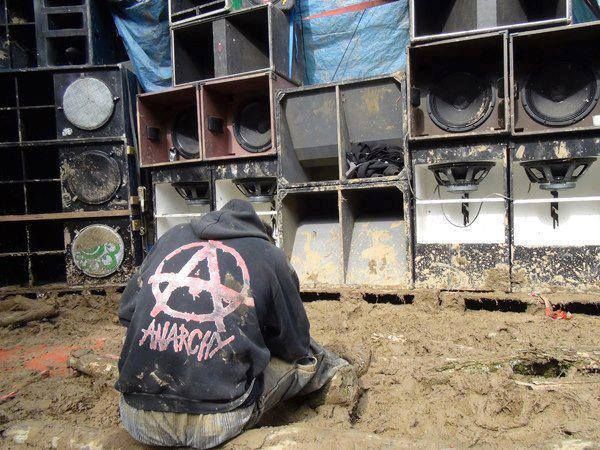
The sound system became the centre of the party. Instead of arriving at a club with a fixed interior, a bar and a professionally designed identity, people could arrive at an empty field and build the environment around the music itself. The location could change from one weekend to the next, and the party could exist for as long as the people running it could keep the sound going.
Castlemorton in 1992 became one of the defining moments of this movement. Around 50,000 people gathered in the Malvern Hills, with dozens of sound systems including Spiral Tribe, DiY, Bedlam and Circus Warp. The event became a major turning point in the history of British free parties and contributed to the political pressure that eventually produced the Criminal Justice Act of 1994. DJ Mag’s history of Castlemorton documents the event through accounts from people involved in the different sound systems.
The visual culture changed with the environment. The bright Acid House look did not disappear, but it now existed alongside military clothing, workwear, camouflage, heavy boots, black T-shirts, patched garments and DIY modifications. Punk, traveller culture and practical clothing became increasingly visible because they made sense for people spending days or weeks moving between parties.
The T-shirt became more specific too. Instead of simply communicating “rave”, it could identify a sound system, a crew or a particular group of people. Wearing one could tell you where someone had come from or who they were travelling with. The garment was still cheap and practical, but it was beginning to work as a marker of belonging.
As the free-party and teknival culture developed, black T-shirts with stark graphics became particularly common. Sound-system names, symbols, abstract patterns and references to free parties appeared across clothing, flyers, stickers and vehicles. Some designs looked closer to underground band merchandise than conventional fashion.
That distinction became increasingly important as free-party culture developed. The party was no longer only somewhere you went. It was something you helped create.
GOA
Goa followed a different route. Its rave culture did not simply come from Britain or Ibiza. Its roots go back to the late 1960s and 1970s, when the Indian state of Goa became part of a wider hippie and traveller route. Academic research by Graham St John describes the seasonal dance-party culture that developed in Goa during the 1970s and 1980s, with travellers and DJs bringing new musical influences into the scene.
During the 1980s, electronic music became increasingly important to the parties. DJs and travellers brought records, cassettes and new sounds from different parts of Europe and mixed them with the existing psychedelic culture. Goa became a place where music from different scenes could be heard in a completely different environment.
Goa Gil became one of the important figures in that transition. Research by Graham St John traces Gil’s journey from the psychedelic scene of 1960s San Francisco to Anjuna in the 1970s, the adoption of electronic music in Goa during the 1980s and the birth of Goa trance during the 1990s.
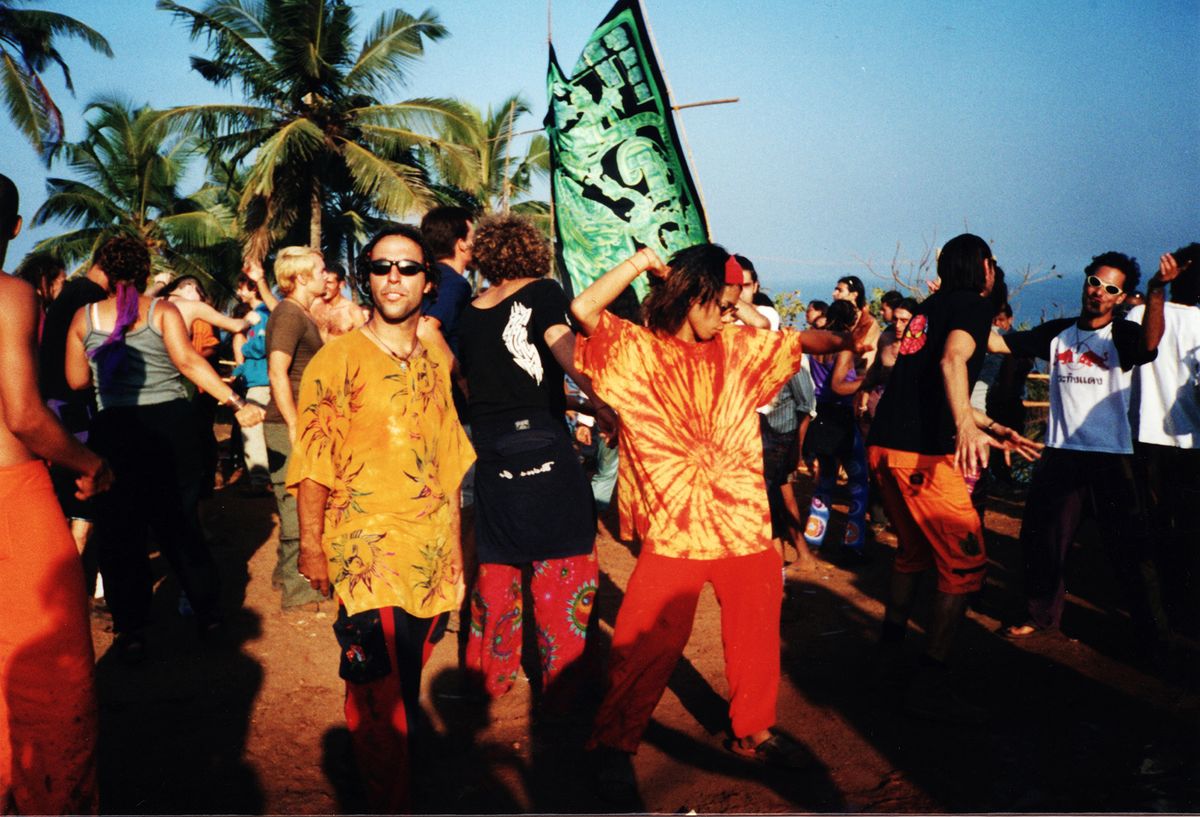
The visual language developed alongside the music. Goa was full of psychedelic imagery, but the graphics went beyond the colourful smileys of Acid House. Fractals, aliens, mushrooms, cosmic landscapes, spiritual imagery and references to technology appeared on flyers and clothing. Black T-shirts covered in complex psychedelic graphics became a familiar part of the scene, often functioning almost like portable versions of the visuals surrounding the parties.
Unlike the relatively simple symbols of Acid House, Goa graphics could become incredibly dense. A single shirt could be covered with fractals, mandalas, science-fiction imagery, psychedelic creatures and fluorescent typography. Black fabric provided the background, while neon greens, pinks, blues and oranges created designs that worked particularly well under ultraviolet light.
The T-shirt was particularly suited to this culture because the graphic could travel. Travellers moving between Europe and India carried music, images and clothing with them, and Goa itself became part of that exchange. Research into Goa trance describes the scene as a culture of movement and exile, with travellers carrying sounds and aesthetics between different countries and cities.
Ibiza was developing in parallel, although along a different trajectory. The island had its own hippie and traveller culture from the 1960s, and before the arrival of the massive commercial club industry, smaller outdoor parties were part of the island’s nightlife. A 2004 guide to the trance scene records Can Punta as one of the major trance locations during the summers of 1991 and 1992.
Goa and Ibiza therefore should not be understood as one scene creating the other. They were different places connected by travellers, DJs, music and the growing international movement of electronic culture.
THE RAVE ON THE ROAD
The movement from free parties to travelling sound systems pushed rave culture beyond the boundaries of individual countries. France became a major centre of teknival culture, while Italy, Spain and other parts of Europe developed their own networks of crews, squats, abandoned industrial spaces and outdoor parties.
Travelling became part of the culture itself. Sound systems could be transported in trucks, vans and caravans, with generators, speakers, records and equipment allowing parties to appear in places that had no conventional nightlife infrastructure. People travelled with them, sometimes moving between countries for months at a time.
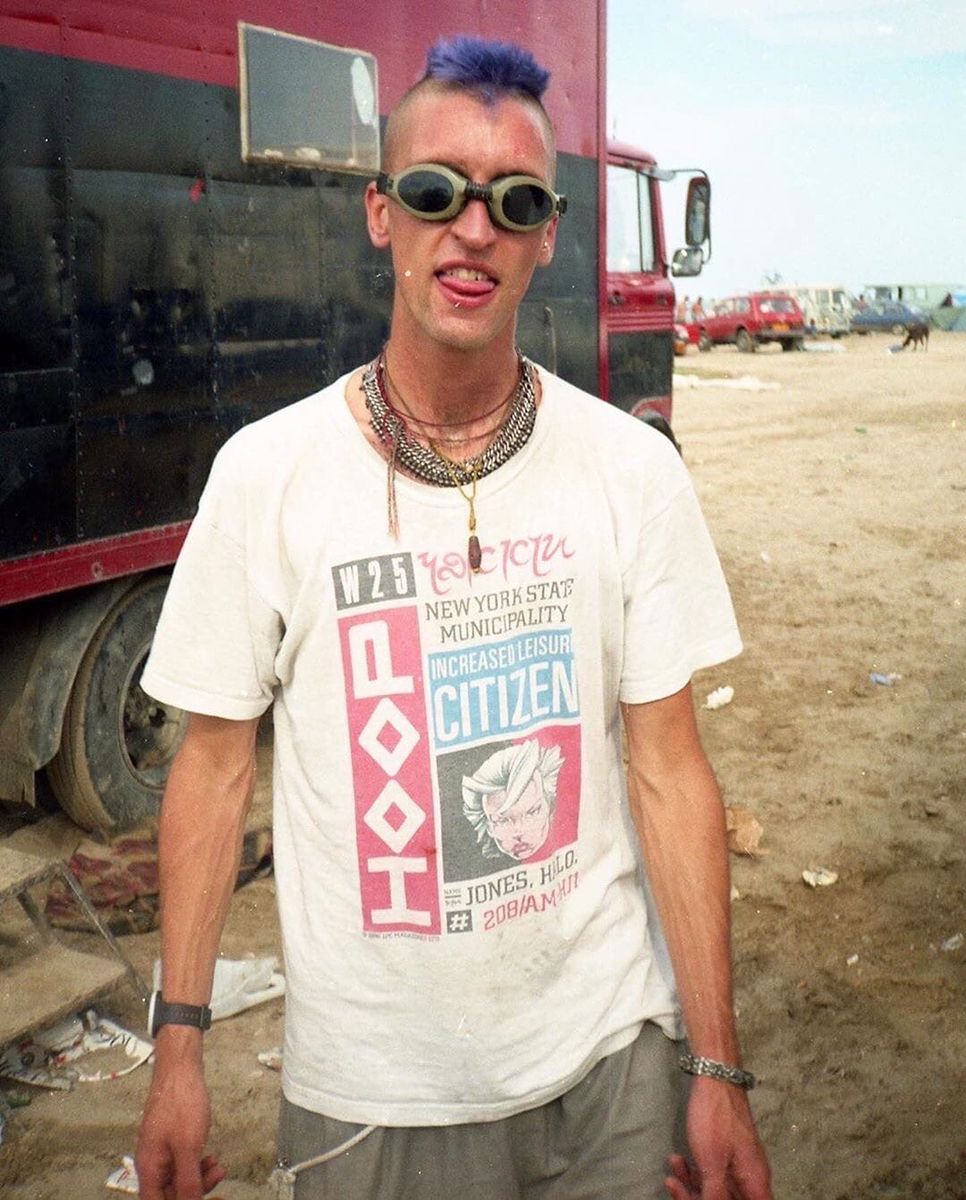
This created a constantly changing mixture of musical and visual references. Hard techno could sit next to acid, hardcore, trance or hardtek, while clothing brought together military surplus, workwear, punk, sportswear and psychedelic graphics. Someone could arrive wearing a black sound-system T-shirt, patched trousers and heavy boots, while the person next to them was wearing a fluorescent Goa shirt and sportswear.
At a single party you could see acid smileys, psychedelic graphics, sound-system logos, festival merchandise and references to different rave movements. Clothing became a collage of scenes, eras and loyalties, a visual map of where each person had been.
Spain became one of the places where these different networks met. The Dragon Festival, which began in the Granada area in 1997, became associated with alternative culture, outdoor electronic music and the wider traveller scene. The festival eventually grew from a small gathering into an event attracting thousands of people.
The movement could also become much more ambitious. The Sound Conspiracy archive documents a group of ravers and free-party people who travelled from Italy through Bosnia, Turkey, Iran and Pakistan before reaching India and Goa. Their journey lasted around 18 months and became the subject of World Traveller Adventure, Mission to India.
At this point, the T-shirt was almost a small piece of the road. A sound-system logo printed in one country could appear on the back of someone thousands of kilometres away. Flyers, stickers, patches and shirts travelled alongside the music, creating a visual record of the network even when the parties themselves were temporary.
The rave was becoming international without necessarily becoming centralised. Different scenes could remain radically different while still being connected by the people who moved between them.
FROM FREE PARTY TO RAVE FESTIVAL
While Goa was developing its own psychedelic electronic culture, the British free-party movement was becoming increasingly nomadic. Spiral Tribe, formed in 1990, became one of the most visible sound systems of this period. Its members were involved in Castlemorton and later became important in spreading the sound-system and free-party model across mainland Europe.
After the British authorities increased pressure on free parties, members of Spiral Tribe left the UK with their mobile studio and convoy of converted vehicles. They eventually arrived in France, where they organised the first Teknival in Beauvais in 1993. DJ Mag’s history of Spiral Tribe documents how this helped launch a wider European teknival movement.
What travelled with them was more than a collection of records and speakers. It was a way of organising parties around mobile sound systems, temporary locations and a strong sense of autonomy.
The teknival emerged from this wider culture. Large gatherings brought multiple sound systems together in temporary locations, particularly in France and later across other parts of Europe. Music became harder, faster and more fragmented, with styles such as hard techno, hardcore and hardtek developing alongside acid, trance and other rave sounds.
The visual language followed the music. Sound-system logos became important, while black clothing, heavy boots, military surplus and DIY graphics became common across the travelling scene. T-shirts were one of the simplest ways to carry the identity of a crew from one location to another.
At the same time, rave culture was beginning to enter the world of organised festivals. The change was not simply a question of bigger crowds. Festivals started incorporating the visual, artistic and social aspects that had previously existed around smaller parties.
Sónar, founded in Barcelona in 1994, connected electronic music with creativity, innovation and technology. Its own history describes the festival as something that grew beyond music into a broader exploration of the relationship between creativity, technology and culture.
Fusion followed another route. The first party at the former military airfield in Lärz took place in 1996 under the name U-Site, and the first Fusion Festival followed in 1997. The organisers describe the space as a long-running cultural project combining music with a much wider range of artistic and social activity.
Burning Man followed a different countercultural path. It began on San Francisco’s Baker Beach in 1986 and moved to the Black Rock Desert in 1990. It was not a British rave festival, but its development around temporary communities, art, participation and self-expression places it within the same broader history of people creating alternative environments outside conventional cultural structures. Burning Man’s official historical archive documents that evolution.
This period also saw the spread of PLUR, meaning Peace, Love, Unity and Respect, which became strongly associated with American rave culture through Frankie Bones and the Storm Rave scene in New York during the early 1990s. In an interview with Insomniac, Bones describes the development of the term and its connection to the culture around his parties.
PLUR was less about how people dressed than about how they behaved towards each other inside the party. But the acronym also became part of rave’s visual language, appearing on clothing, accessories and other objects associated with the scene.
That distinction is useful when looking at rave clothing. By this point there were increasingly recognisable styles, but there was no single uniform. A T-shirt could identify a sound system, an event, a record label or simply carry a graphic that somebody liked. Clothing remained connected to the scene, but it was becoming easier to separate the visual reference from the actual experience behind it.
RAVE CULTURE: WHAT COMES NEXT
Today, those different histories have become part of one enormous visual archive. Acid House graphics sit alongside techno typography, Goa psychedelia alongside cyberpunk, industrial black alongside fluorescent colour. Punk, sportswear, military clothing, workwear and futuristic materials can all appear in the same outfit without necessarily feeling contradictory.
The difference is that the references are now much easier to access. A designer, musician or fashion brand can look at forty years of rave culture from a laptop and immediately borrow its visual language. The original T-shirt might have identified a sound system or documented a specific night, while a contemporary rave T-shirt can simply reference the atmosphere or history of the culture.
That creates an interesting tension between reference and costume. A smiley does not automatically make something Acid House, just as putting a Spiral Tribe reference on a black shirt does not recreate the free-party movement. The more familiar these symbols become, the more interesting it becomes to use them without simply reproducing them.
This is also where contemporary projects such as Kuldrop can exist. Kuldrop is an urban project built around a collective of artists who share a similar philosophy and way of looking at the world. Its visual language can move across different cultural references, and rave culture is one of the spaces where that language naturally fits. Different references and different styles can coexist while still feeling connected. The same collective instinct is there: make things yourself, find your people, share references and build something together.
That kind of hybridisation is also visible in the music itself. A contemporary set can move from downtempo to jungle, drum & bass and techno without treating those genres as separate worlds. The same thing happens visually. Lunar Punk can sit next to Solar Punk, underground darkness next to optimism, technology next to nature, industrial references next to community and collective imagination.
Rave culture has always absorbed what was around it and turned it into something else. The next generation will probably do the same, taking references from decades of music, fashion, graphics and subcultures and mixing them with whatever is happening now.
The rave has never really been one aesthetic. It has always been a network of people, sounds, places and references moving into each other.
And somewhere in that process, someone will probably print a T-shirt that makes perfect sense to the people who are there and absolutely no sense to anyone else.
That is part of the point.
Frequently Asked Questions
What is rave culture?
Rave culture is a broad network of music, parties, fashion, art and social communities that developed around electronic dance music. It has included club nights, warehouse parties, free parties, sound systems, festivals and travelling scenes.
How did rave culture influence fashion?
Rave culture influenced fashion through practical clothing, sportswear, military and workwear, psychedelic graphics, DIY customisation and T-shirts connected to specific parties, sound systems and musical scenes.
What did people wear to raves in the 1990s?
There was no single rave outfit. Clothing varied between scenes, but commonly included T-shirts, trainers, loose clothing, sportswear, military surplus, workwear, black clothing, psychedelic graphics and DIY modifications.
What are rave T-shirts?
Rave T-shirts are graphic T-shirts connected to rave culture, electronic music scenes, parties, festivals, sound systems or the visual language surrounding them. They can function as merchandise, souvenirs, identity markers or simply as graphic expressions of the culture.
How did Acid House influence rave graphics?
Acid House helped popularise bright colours, smiley faces, psychedelic imagery, distorted typography and DIY flyer aesthetics. These visual elements moved from flyers and club promotions into clothing, T-shirts and later mainstream fashion.
-

Curves V.1
€29,95 View Details This product has multiple variants. The options may be chosen on the product page -

Jungle macadam V.1
€29,95 View Details This product has multiple variants. The options may be chosen on the product page -

Abstract Odyssey V.2
€25,00 View Details This product has multiple variants. The options may be chosen on the product page